 Breaking News & Live Updates
- Breaking News & Live Updates
- Breaking News & Live Updates
- Breaking News & Live Updates
- Breaking News & Live Updates
- Breaking News & Live Updates
- Breaking News & Live Updates
- Breaking News & Live Updates
- Breaking News & Live Updates
- Breaking News & Live Updates
Understanding Cognitive Dissonance: Everyday Manifestations and Resolutions
Cognitive dissonance, a state of mental unease stemming from contradictory thoughts, beliefs, or actions, frequently surfaces in our daily lives, influencing our decisions and perceptions. This psychological phenomenon presents a spectrum of outcomes, from detrimental rationalizations to constructive self-improvement, as individuals strive to reconcile internal inconsistencies. Whether confronted with environmental responsibilities, personal health choices, or financial commitments, the human mind instinctively seeks harmony, often leading to fascinating adaptive strategies.

Individuals employ diverse methods to mitigate the discomfort of conflicting cognitions. For instance, an environmentally conscious person who drives a car daily might choose to switch to public transport, initiate carpooling, rationalize their driving as essential for punctuality, or dismiss the impact of their personal emissions. Within interpersonal relationships, conflicting perceptions of a partner's commitment can lead to justifications that may either preserve an unhealthy bond or, conversely, empower one to seek a more fulfilling connection. Professionally, facing an ethical dilemma at work can prompt either rationalization of company practices or a proactive search for a more values-aligned career path.
Ultimately, navigating the complexities of cognitive dissonance requires self-awareness and a willingness to confront uncomfortable truths. While it can sometimes lead to self-deception or the perpetuation of unhealthy patterns, the inherent drive to resolve this internal conflict also offers a powerful catalyst for positive change and personal growth. By actively engaging with our conflicting thoughts and behaviors, we can foster greater authenticity, make more informed decisions, and cultivate a life that genuinely aligns with our core values and aspirations.
Other Articles
 Feb 20, 2026
Understanding Cognitive Dissonance: Theories and Manifestations
Cognitive dissonance, a psychological discomfort stemming from conflicting thoughts or actions, propels individuals to seek consistency. Originating from Leon Festinger's foundational work, this phenomenon has inspired numerous theories exploring how people reconcile internal inconsistencies, ranging from self-concept alignment to effort justification and belief preservation. It sheds light on our innate drive to maintain mental harmony.
 Feb 17, 2026
Understanding Cognitive Dissonance: Everyday Conflicts of Mind
Cognitive dissonance is a psychological phenomenon that frequently appears in daily life, causing internal conflict and discomfort. This mental state arises when an individual holds two or more conflicting beliefs, values, or behaviors. Such inconsistencies can stem from various sources, including discrepancies between beliefs and actions, difficult decision-making processes, external social pressures, and challenging moral or ethical predicaments.
 Feb 14, 2026
Understanding Cognitive Dissonance: The Mind's Internal Conflict
Cognitive dissonance is the mental discomfort experienced when one's beliefs, values, or ideas conflict with each other or with one's actions. This psychological phenomenon, first theorized by Leon Festinger in 1957, often leads to negative emotions like guilt or anxiety. While unpleasant, it can also serve as a powerful motivator for personal change, prompting individuals to resolve inconsistencies by altering their thoughts or behaviors to achieve internal harmony.
 Feb 11, 2026
Exploring the Delay in Emotional Responses Among Autistic Individuals
This article explores the phenomenon of delayed emotional responses often experienced by autistic individuals. It clarifies common misunderstandings that arise from this processing style, emphasizing that such emotions are valid. The piece offers practical advice for autistic people on self-management and provides guidance for their support networks, highlighting communication and self-compassion as key strategies.
 Feb 08, 2026
The Intricacies of Delayed Emotional Responses
Delayed emotional responses, characterized by a lag between an event and the subsequent emotional expression, can profoundly impact individuals and their relationships. This phenomenon often leads to misunderstandings, as others may not connect the delayed reaction to its original trigger. Such responses can manifest as initial numbness followed by an eventual outpouring of feeling, affecting personal relationships, professional interactions, self-esteem, and overall mental well-being.
 Feb 05, 2026
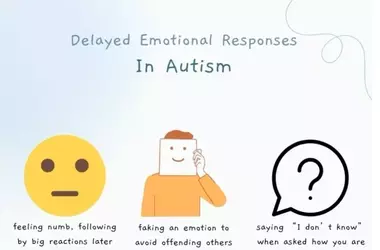
Understanding Delayed Emotional Responses in Autism
Many autistic individuals experience emotions with a delay, often hours or days after an event, which is not indifference but a characteristic of autistic processing. This phenomenon is influenced by factors such as sensory overload, detailed cognitive processing, alexithymia, and emotional masking, all of which contribute to the deferred experience and expression of feelings.