 Breaking News & Live Updates
- Breaking News & Live Updates
- Breaking News & Live Updates
- Breaking News & Live Updates
- Breaking News & Live Updates
- Breaking News & Live Updates
- Breaking News & Live Updates
- Breaking News & Live Updates
- Breaking News & Live Updates
- Breaking News & Live Updates
Exploring the Delay in Emotional Responses Among Autistic Individuals
This piece delves into the nuanced world of emotional processing for individuals on the autism spectrum, offering both insights into common challenges and practical strategies for navigation.
Embrace Your Emotional Rhythm: Validating Delayed Responses in Autism
Unpacking Misinterpretations of Emotional Expression
When emotions manifest at a later stage, observers may mistakenly label these reactions as excessive or melodramatic. Initially, a calm demeanor might lead others to infer a lack of concern, causing them to dismiss subsequent emotional displays as unrelated to the original event. These prevalent misunderstandings underscore the concept of the double empathy problem, illustrating the inherent difficulties autistic and non-autistic individuals face in comprehending each other's perspectives. For those with autism, this often results in unjust judgments, fostering feelings of shame or self-doubt. It is crucial to remember that your feelings are authentic and legitimate, irrespective of their timing.

Empowering Self-Support Strategies for Autistic Individuals
This section provides actionable guidance, categorized for autistic readers grappling with their own delayed emotional processing and for caregivers, friends, or therapists aiding an autistic person through these experiences. The core message is to acknowledge this processing style as a legitimate facet of neurological diversity, rather than a personal deficiency or something requiring rectification. Release the pressure to react immediately; grant yourself permission to experience emotions according to your own internal clock. Attempting to force an immediate emotional response to conform to external expectations can, in fact, exacerbate distress. It's perfectly acceptable to state, “I am still processing this.”
Fostering Open Communication about Emotional Processing
If you feel at ease, consider informing close companions or family members about this aspect of your autistic experience. Clarify that you may require additional time to process emotionally charged situations. For instance, you might articulate, “Sometimes, I don't fully grasp my feelings about something until a day or two later.” By establishing this expectation, you alleviate self-imposed pressure and assist others in accurately interpreting your responses. Furthermore, you can mutually agree with loved ones to reconnect once you have had the opportunity to sort through your emotions. In professional or personal relationships, this might translate to: “I am not prepared to discuss my emotions at this moment, but I will get back to you tomorrow.”
Documenting Emotional Journeys for Greater Insight
Consider maintaining a journal, utilizing a notes application, or creating voice memos to document emotional occurrences. Recording events and revisiting them later can facilitate the connection between the incident and your delayed emotional reaction. For example, if something upsetting transpires, make a brief note. A day or two subsequent, log your feelings. Over time, you may identify recurring patterns, such as consistently feeling the impact the following morning. This practice can also be validating, confirming in writing that you did indeed experience emotions, thereby reinforcing the authenticity of your feelings, even with a delay.
Developing Resilient Coping Mechanisms for Emotional Surges
When these deferred emotions eventually emerge, their intensity can be considerable. Prepare a repertoire of grounding techniques or calming activities for moments of sudden overwhelm. This could encompass deep breathing exercises, listening to tranquil music, retreating to a low-sensory environment, comforting a pet or a weighted blanket, or engaging in stimming behaviors like rocking or hand-flapping to release accumulated emotions. By proactively planning self-soothing methods, you will navigate these delayed emotional waves with greater ease. Moreover, remind yourself in those instances that this surge is transient—it is simply the belated processing of a past experience. If necessary, reach out to a trusted friend or therapist for support and validation during these times. You are entitled to the time and space to feel without judgment.
Other Articles
 Feb 08, 2026
The Intricacies of Delayed Emotional Responses
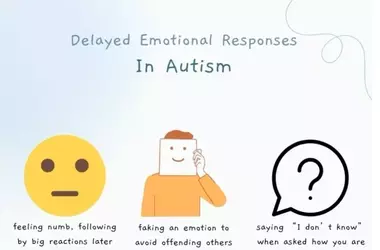
Delayed emotional responses, characterized by a lag between an event and the subsequent emotional expression, can profoundly impact individuals and their relationships. This phenomenon often leads to misunderstandings, as others may not connect the delayed reaction to its original trigger. Such responses can manifest as initial numbness followed by an eventual outpouring of feeling, affecting personal relationships, professional interactions, self-esteem, and overall mental well-being.
 Feb 05, 2026
Understanding Delayed Emotional Responses in Autism
Many autistic individuals experience emotions with a delay, often hours or days after an event, which is not indifference but a characteristic of autistic processing. This phenomenon is influenced by factors such as sensory overload, detailed cognitive processing, alexithymia, and emotional masking, all of which contribute to the deferred experience and expression of feelings.
 Feb 03, 2026
Navigating Childhood Anxiety: A Comprehensive Guide for Parents and Educators
This article explores the complexities of childhood anxiety, providing guidance for parents and educators on distinguishing normal developmental anxieties from anxiety disorders. It discusses common symptoms, the importance of facing fears, and when to seek professional help. The piece also delves into effective treatment approaches, such as Cognitive Behavioral Therapy (CBT) and exposure therapy, offering insights into supporting children's mental well-being.
 Jan 01, 2026
Fitness Trackers Accurately Identify Mood Episodes in Bipolar Disorder
A recent study highlights the capability of fitness trackers to detect mood episodes in individuals with bipolar disorder. Utilizing passively collected, non-invasive data combined with machine learning, researchers achieved high accuracy in identifying both manic and depressive states. These findings suggest a significant advancement in real-time mental health monitoring, offering a promising avenue for improving clinical care by enabling earlier intervention and personalized treatment strategies.
 Jan 10, 2026
Parental Mental Illness Escalates Risk of Childhood Psychopathology
A recent extensive study confirms a heightened risk of mental health challenges in children whose parents live with schizophrenia or bipolar disorder, in contrast to their peers whose parents do not have such diagnoses. Spanning four years, the research observed 238 children, noting distinct symptom patterns tied to the specific parental diagnosis. Children with a parent diagnosed with schizophrenia frequently displayed attention deficits, disruptive behaviors, and subclinical psychotic tendencies, whereas those with bipolar parents more often exhibited mood-related symptoms and subclinical bipolar indicators. The study also identified protective elements like robust parental functionality and elevated socioeconomic status as factors that mitigate these risks, underscoring the critical need for early monitoring and supportive interventions.
 Jan 05, 2026
Dopamine Rhythms Linked to Bipolar Mood Swings
New research suggests that the mood fluctuations in bipolar disorder may be driven by two biological clocks: the body's daily circadian rhythm and a distinct dopamine-based system controlling alertness. When these two internal timing mechanisms synchronize at particular moments, they might trigger the characteristic shifts between manic and depressive states. This groundbreaking discovery could pave the way for novel treatments that target the dopamine clock to alleviate the frequency and intensity of mood episodes.