 Breaking News & Live Updates
- Breaking News & Live Updates
- Breaking News & Live Updates
- Breaking News & Live Updates
- Breaking News & Live Updates
- Breaking News & Live Updates
- Breaking News & Live Updates
- Breaking News & Live Updates
- Breaking News & Live Updates
- Breaking News & Live Updates
The Intricacies of Delayed Emotional Responses
The phenomenon of delayed emotional responses, where feelings surface long after the provoking incident, presents a complex challenge for both the individual experiencing them and those around them. This temporal discrepancy in emotional processing can lead to a cascade of misunderstandings, eroding personal connections, complicating professional dynamics, and ultimately undermining one's self-perception and mental fortitude. It's a journey from an initial emotional void to a subsequent, sometimes overwhelming, wave of feeling, often leaving observers perplexed by the seemingly unprovoked reactions.
A common manifestation of this emotional lag is an initial state of numbness following a distressing event, only for intense emotions, such as tears, to emerge days later during unrelated, mundane activities. This disconnect can be particularly bewildering for others, who might question the timing of the reaction, unaware of the internal processing at play. The absence of an immediate emotional display can be misconstrued as indifference or detachment, creating a chasm in understanding between individuals whose emotional timelines simply do not align. For instance, a partner might perceive a lack of immediate distress as a sign of apathy, while the individual is, in fact, deeply affected but processing their feelings on a different schedule.

The repercussions of such delayed emotional processing extend into various facets of life. In interpersonal relationships, this temporal mismatch can foster mistrust and frustration. Loved ones might feel unacknowledged or believe their concerns are not taken seriously when an immediate emotional response is absent. This gradual erosion of understanding can lead to significant emotional distance. Professionally, absorbing criticism silently and reacting much later can cause colleagues to misinterpret the initial silence as agreement or disengagement, hindering effective communication, collaborative efforts, and conflict resolution.
Internally, the struggle with delayed emotions can profoundly impact self-esteem. When one's emotional reality remains hidden from others, individuals may begin to doubt the validity of their own feelings, questioning if their reactions are 'normal' or 'justified.' This internal conflict can lead to feelings of fraudulence, especially when societal expectations lean towards immediate emotional expression. Over time, this dissonance contributes to a weakened sense of self-confidence and a tendency towards self-judgment. The cumulative effect of unaddressed emotions, coupled with the pressure to mask true feelings and navigate interpersonal strains, can significantly exacerbate mental health challenges, including heightened stress, anxiety, depression, and burnout. Each unprocessed event adds to an emotional backlog, diminishing resilience and increasing emotional fatigue.
Ultimately, navigating the landscape of delayed emotional responses requires both self-awareness and empathy. Recognizing that emotional processing varies from person to person is crucial for fostering healthier relationships and a more supportive environment. Understanding that a delayed reaction does not signify a lack of feeling, but rather a different rhythm of emotional integration, can help mitigate misunderstandings and reduce the isolating impact on individuals who experience this unique emotional timeline.
Other Articles
 Feb 05, 2026
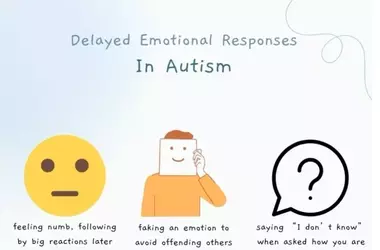
Understanding Delayed Emotional Responses in Autism
Many autistic individuals experience emotions with a delay, often hours or days after an event, which is not indifference but a characteristic of autistic processing. This phenomenon is influenced by factors such as sensory overload, detailed cognitive processing, alexithymia, and emotional masking, all of which contribute to the deferred experience and expression of feelings.
 Feb 03, 2026
Navigating Childhood Anxiety: A Comprehensive Guide for Parents and Educators
This article explores the complexities of childhood anxiety, providing guidance for parents and educators on distinguishing normal developmental anxieties from anxiety disorders. It discusses common symptoms, the importance of facing fears, and when to seek professional help. The piece also delves into effective treatment approaches, such as Cognitive Behavioral Therapy (CBT) and exposure therapy, offering insights into supporting children's mental well-being.
 Jan 01, 2026
Fitness Trackers Accurately Identify Mood Episodes in Bipolar Disorder
A recent study highlights the capability of fitness trackers to detect mood episodes in individuals with bipolar disorder. Utilizing passively collected, non-invasive data combined with machine learning, researchers achieved high accuracy in identifying both manic and depressive states. These findings suggest a significant advancement in real-time mental health monitoring, offering a promising avenue for improving clinical care by enabling earlier intervention and personalized treatment strategies.
 Jan 10, 2026
Parental Mental Illness Escalates Risk of Childhood Psychopathology
A recent extensive study confirms a heightened risk of mental health challenges in children whose parents live with schizophrenia or bipolar disorder, in contrast to their peers whose parents do not have such diagnoses. Spanning four years, the research observed 238 children, noting distinct symptom patterns tied to the specific parental diagnosis. Children with a parent diagnosed with schizophrenia frequently displayed attention deficits, disruptive behaviors, and subclinical psychotic tendencies, whereas those with bipolar parents more often exhibited mood-related symptoms and subclinical bipolar indicators. The study also identified protective elements like robust parental functionality and elevated socioeconomic status as factors that mitigate these risks, underscoring the critical need for early monitoring and supportive interventions.
 Jan 05, 2026
Dopamine Rhythms Linked to Bipolar Mood Swings
New research suggests that the mood fluctuations in bipolar disorder may be driven by two biological clocks: the body's daily circadian rhythm and a distinct dopamine-based system controlling alertness. When these two internal timing mechanisms synchronize at particular moments, they might trigger the characteristic shifts between manic and depressive states. This groundbreaking discovery could pave the way for novel treatments that target the dopamine clock to alleviate the frequency and intensity of mood episodes.
 Jan 14, 2026
Harmonizing Sounds and Scenery: Boosts for Mental Well-being
Scientific findings indicate that engaging with both music and natural surroundings can significantly improve emotional and physical health. A recent study highlights that integrating these experiences—such as listening to melodies in outdoor settings, tending to gardens while singing, or interacting with animals—can elevate mood, alleviate stress, and diminish symptoms of anxiety and depression. These innovative, multi-sensory approaches offer accessible, cost-effective methods for individuals of all ages, including those recovering from trauma or older adults with cognitive decline, to enhance their overall health.