 Breaking News & Live Updates
- Breaking News & Live Updates
- Breaking News & Live Updates
- Breaking News & Live Updates
- Breaking News & Live Updates
- Breaking News & Live Updates
- Breaking News & Live Updates
- Breaking News & Live Updates
- Breaking News & Live Updates
- Breaking News & Live Updates
Child's Gaze Reveals Early Depression Indicators
New research underscores the intricate link between children's visual attention and the onset of depression. This groundbreaking study emphasizes that these attentional biases are not mere byproducts of sadness but active, evolving susceptibilities, shaped significantly by a family's history of mental health conditions.
Detailed Report on Childhood Depression and Eye Movements
In a significant longitudinal study conducted by Binghamton University, researchers have unveiled a compelling, reciprocal relationship between emerging depressive symptoms in children and their patterns of visual attention. From June 2026, for a duration of two years, a cohort of 242 children and their mothers participated in this pioneering investigation. Employing state-of-the-art eye-tracking technology, the research team meticulously recorded the duration for which children focused on facial expressions conveying happiness, sadness, or anger, in contrast to neutral expressions.
The findings illuminate a striking divergence in neural and psychological processing, primarily determined by a child's familial predisposition to major depressive disorder (MDD). For youngsters with a maternal history of depression, escalating depressive indicators led to an 'attention trap.' Their gaze became increasingly fixated on, and reluctant to disengage from, sad countenances, thereby impairing their capacity to shift focus from negative environmental stimuli.
Conversely, among children with no family history of depression, a deteriorating mood manifested differently. Instead of seeking out sadness, it appeared to erode a natural protective mechanism, causing them to neglect and turn away from positive visual cues, such as joyful faces. This pivotal research highlights that attentional biases are dynamic vulnerabilities that develop over time, closely aligned with family history, rather than passive consequences of low mood.
This study represents the first of its kind to establish a 'transactional relationship' where shifts in mood and visual focus mutually predict and amplify each other. Dr. Brandon Gibb, director of the Mood Disorders Institute at Binghamton, emphasized the importance of observing these vulnerabilities as they emerge, rather than after they become entrenched. Kelly Gair, a PhD student and lead author, underscored the novelty of examining these reciprocal predictions over time.
The researchers, including Leslie A. Brick from the University of New Mexico, conducted assessments every six months. During these sessions, children viewed pairs of faces—one neutral, one emotional—while eye-tracking equipment precisely monitored their gaze. The results indicate that the impact of depressive symptoms on attention varies significantly with a child’s family background. Children of mothers with a history of MDD, when experiencing their own depressive symptoms, showed a heightened tendency to focus on sad faces. Dr. Gibb noted that these at-risk children increasingly lose the ability to divert their attention from negative stimuli as their depression deepens. Gair hypothesized that consistent exposure to maternal sadness during formative years might make these expressions exceptionally prominent and overwhelming when the child experiences their own emotional distress, leading to an increased fixation on sad expressions.
In contrast, children without a maternal history of depression, when experiencing increased depressive symptoms, exhibited reduced attention to happy faces. Dr. Gibb explained that for these lower-risk children, depression erodes a protective factor—their natural inclination to engage with positive emotional signals. The research team plans to continue tracking this cohort into adolescence to determine how these specific gaze patterns might predict clinical diagnoses later in life.
Insights from the Study: A Glimpse into Early Detection
This groundbreaking research offers profound insights into the subtle yet significant ways in which depression begins to manifest in children, underscoring the dynamic interplay between emotional state and visual processing. It powerfully suggests that our attentional patterns are not merely passive responses to our feelings but active agents that can either reinforce negative cycles or, conversely, protect us from them. The study’s innovative use of eye-tracking technology moves beyond subjective self-reporting, providing an objective window into the developing mind. From a societal perspective, this work opens exciting new avenues for early intervention. Imagine a future where pediatric check-ups include non-invasive eye-tracking tests that could flag children at risk, allowing for preventative care and support before depressive symptoms escalate. This could revolutionize child mental health, shifting from reactive treatment to proactive prevention. It reminds us that even seemingly small behavioral cues, like where a child’s eyes linger, can hold the key to understanding complex psychological states and intervening effectively to foster healthier emotional development.
Other Articles

General AI Models Outperform Specialized Medical AI
A recent study published in Nature Medicine challenges the long-held belief that specialized AI models are superior in the medical field. The research indicates that general-purpose AI, such as GPT-5.2 and Gemini 3.1 Pro, consistently outperform their specialized counterparts, like OpenEvidence and UpToDate Expert AI, across various medical tasks. This surprising finding suggests that the vast training data of frontier models provides a broader and deeper understanding, making incremental specialized training less impactful than previously assumed.

Global Escalation of Mental Health Conditions and Inadequate Treatment
A recent Lancet study reveals a significant increase in mental disorders worldwide, nearly doubling since 1990. Mental illnesses now rank as the fifth leading cause of disability-adjusted life-years globally, with anxiety and depression being prominent. The study highlights persistent, large treatment gaps, particularly in lower-income regions, underscoring an urgent need for enhanced surveillance, early intervention, and inclusive policies tailored to diverse populations.

The Dual Impact of the World Cup: Unpacking Fan Psychology and Societal Effects
The FIFA World Cup, a global spectacle, profoundly influences individuals and societies. While losses can elevate cardiovascular risks for passionate fans, wins offer fleeting boosts in well-being. Beyond individual responses, the tournament shapes collective memory and national pride. However, this unity can be shadowed by heightened biases against certain out-groups, revealing a complex interplay of positive and negative psychological and social outcomes.
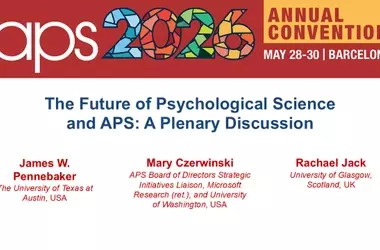
Navigating the Evolution of Psychological Science and APS: A Plenary Discussion
This plenary session explores the dynamic landscape of psychological science and the American Psychological Society (APS), addressing the significant transformations impacting the field. Chaired by James W. Pennebaker, the discussion features insights from Pennebaker, Mary P. Czerwinski, and Rachael E. Jack on challenges, professional development, and the urgent need for global collaboration within the discipline.

The Dynamics of Civilizational Decline: A Psychological Perspective
This discussion explores the factors contributing to the decline and eventual collapse of businesses, communities, and entire civilizations. Drawing on insights from psychological science, the panel investigates the destabilizing elements affecting large groups, examines contemporary signs of decline in Western societies, and considers how psychological researchers can contribute to understanding and addressing these complex challenges.

The Impact of AI and LLMs on Psychological Science
This article discusses the profound shifts artificial intelligence and large language models (LLMs) are bringing to psychological science. A panel of experts, including James W. Pennebaker, Alex Bentley, Ian Morris, and Stephan Lewandowsky, will explore how these technologies are reshaping our understanding of statistics, predictions, theories, and human cognition. The session, supported by the Alan Kraut-Jane Steinberg Family Fund, aims to foster dialogue on these transformative developments.