 Breaking News & Live Updates
- Breaking News & Live Updates
- Breaking News & Live Updates
- Breaking News & Live Updates
- Breaking News & Live Updates
- Breaking News & Live Updates
- Breaking News & Live Updates
- Breaking News & Live Updates
- Breaking News & Live Updates
- Breaking News & Live Updates
General AI Models Outperform Specialized Medical AI
A recent study has upended conventional wisdom in the digital health sector, revealing that general-purpose artificial intelligence models are proving more effective in medical applications than highly specialized ones. This finding challenges the prevalent assumption that an AI trained extensively on curated medical data would inherently surpass broader AI systems. The research indicates that leading general AI models, with their vast and diverse datasets, are demonstrating superior performance in various clinical scenarios, suggesting a potential paradigm shift in the development and deployment of healthcare AI.
For a considerable period, the digital health industry has placed significant value on AI models specifically tailored for medical use. The underlying rationale was simple: integrate comprehensive medical knowledge into an advanced AI framework, thereby creating a tool physicians could confidently rely on, unlike a generic chatbot. This belief led to substantial investments, with companies like OpenEvidence securing hundreds of millions of dollars, and established platforms such as UpToDate developing their own AI layers based on the premise that more medical knowledge would equate to better medical intelligence. However, a recent publication in 'Nature Medicine' presents compelling evidence that contradicts this intuitive hypothesis.
To understand this counter-intuitive outcome, it's crucial to consider the sheer scale of data involved. While the entire body of biomedical literature encompasses hundreds of billions of words, advanced general AI models are trained on trillions of words. This means that specialized medical training is not building knowledge from scratch but rather adding a relatively small fraction of information to an already immensely knowledgeable system. The incremental contribution of specialized datasets, when compared to the vast existing knowledge base covering medicine, biology, chemistry, statistics, and pharmacology, appears to be marginal, potentially accounting for less than one-tenth of one percent of what a standard model already comprehends. The study's results suggest that this marginal addition is no longer significant enough to confer a noticeable advantage.
Researchers at NYU Langone conducted a comparative analysis, pitting specialized medical AIs like OpenEvidence and UpToDate Expert AI against three frontier models: GPT-5.2, Gemini 3.1 Pro, and Claude Opus 4.6. The evaluation encompassed medical licensing examinations, clinician-alignment benchmarks, and a set of 100 actual physician queries derived from real-world clinical practice. Practicing clinicians, unaware of which model generated the responses, blindly reviewed the results. The outcome was decisive: the general-purpose frontier models emerged victorious across all three assessment categories. Furthermore, the specialized clinical tools performed no better than Google Search AI Overview, a browser feature that is freely available and often overlooked. This striking revelation suggests that purpose-built clinical AI, despite being marketed and priced as premium tools for physicians, are delivering performance comparable to a standard, free browser function.
This situation is not unprecedented. The medical field is not the first to invest heavily in specialized AI, only to find general models performing at a similar level. In 2023, Bloomberg's significant investment in BloombergGPT, a financial model trained on billions of proprietary market data tokens, was based on a similar argument: finance, like medicine, was considered too specialized and critical for general models to master. Yet, despite access to an extraordinary volume of exclusive information, BloombergGPT's performance on financial tasks was found to be comparable to that of general-purpose AI models. This historical parallel reinforces the current findings in medical AI, indicating a broader trend.
The core issue is not whether medical expertise holds importance; it unequivocally does. Instead, the question revolves around where true value lies when general intelligence systems become broadly capable of handling tasks that specialized models were once expected to dominate. If frontier models consistently meet or exceed the performance of specialized clinical AI, the competitive advantage will inevitably shift. Future utility and differentiation are likely to emerge from other domains, including proprietary clinical data, seamless workflow integration, institutional trust, robust governance, regulatory expertise, and the challenging yet critical ability to implement these technologies within actual healthcare environments. In essence, as the AI model itself becomes a foundational infrastructure, the value will migrate up the technological stack, towards aspects that fine-tuning a general-purpose model simply cannot achieve alone.
It is important to acknowledge the limitations highlighted by the study's authors. Highly niche or complex medical tasks might still benefit from domain-specific approaches. A single, obscure clinical detail can, in certain circumstances, be critically important. These exceptional cases are real, but their prevalence is diminishing as general AI capabilities advance. Historically, healthcare AI's identity was built on the premise that clinical complexity necessitated clinical specialization. However, current evidence suggests that this specialized layer is becoming less crucial than previously believed, largely because the foundational general AI models have evolved to an extraordinary level of competence. The competitive barrier, once considered robust, has proven to be impermanent.
Other Articles

Global Escalation of Mental Health Conditions and Inadequate Treatment
A recent Lancet study reveals a significant increase in mental disorders worldwide, nearly doubling since 1990. Mental illnesses now rank as the fifth leading cause of disability-adjusted life-years globally, with anxiety and depression being prominent. The study highlights persistent, large treatment gaps, particularly in lower-income regions, underscoring an urgent need for enhanced surveillance, early intervention, and inclusive policies tailored to diverse populations.

The Dual Impact of the World Cup: Unpacking Fan Psychology and Societal Effects
The FIFA World Cup, a global spectacle, profoundly influences individuals and societies. While losses can elevate cardiovascular risks for passionate fans, wins offer fleeting boosts in well-being. Beyond individual responses, the tournament shapes collective memory and national pride. However, this unity can be shadowed by heightened biases against certain out-groups, revealing a complex interplay of positive and negative psychological and social outcomes.
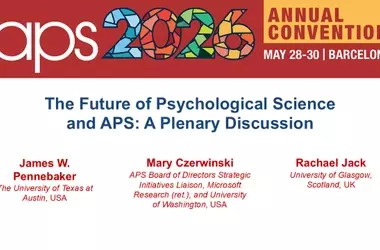
Navigating the Evolution of Psychological Science and APS: A Plenary Discussion
This plenary session explores the dynamic landscape of psychological science and the American Psychological Society (APS), addressing the significant transformations impacting the field. Chaired by James W. Pennebaker, the discussion features insights from Pennebaker, Mary P. Czerwinski, and Rachael E. Jack on challenges, professional development, and the urgent need for global collaboration within the discipline.
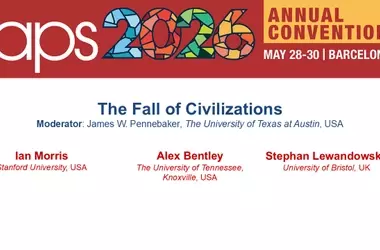
The Dynamics of Civilizational Decline: A Psychological Perspective
This discussion explores the factors contributing to the decline and eventual collapse of businesses, communities, and entire civilizations. Drawing on insights from psychological science, the panel investigates the destabilizing elements affecting large groups, examines contemporary signs of decline in Western societies, and considers how psychological researchers can contribute to understanding and addressing these complex challenges.
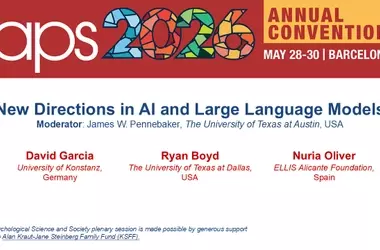
The Impact of AI and LLMs on Psychological Science
This article discusses the profound shifts artificial intelligence and large language models (LLMs) are bringing to psychological science. A panel of experts, including James W. Pennebaker, Alex Bentley, Ian Morris, and Stephan Lewandowsky, will explore how these technologies are reshaping our understanding of statistics, predictions, theories, and human cognition. The session, supported by the Alan Kraut-Jane Steinberg Family Fund, aims to foster dialogue on these transformative developments.

The Enduring Debate: Trauma, Memory, and the Body's Score
The phrase "the body keeps the score" has become widely popular, reflecting the widespread belief that trauma significantly impacts physical well-being. However, the underlying concept that traumatic memories are repressed within the body, unconsciously influencing current symptoms, is a contentious idea with a long and debated history in psychological science. This article examines the resurgence of this theory, particularly in popular culture, and scrutinizes the scientific validity of repressed memories and alternative therapies.