 Breaking News & Live Updates
- Breaking News & Live Updates
- Breaking News & Live Updates
- Breaking News & Live Updates
- Breaking News & Live Updates
- Breaking News & Live Updates
- Breaking News & Live Updates
- Breaking News & Live Updates
- Breaking News & Live Updates
- Breaking News & Live Updates
The Dynamics of Civilizational Decline: A Psychological Perspective
Understanding the processes that lead to the downfall of large-scale social structures, from businesses to communities and even entire civilizations, is a critical area of inquiry. A panel of distinguished experts, featuring James W. Pennebaker from the University of Texas at Austin, Alex Bentley from The University of Tennessee, Knoxville, Ian Morris from Stanford University, and Stephan Lewandowsky from the University of Bristol, delves into the intricate factors that can undermine the stability of complex human organizations.
The discussion probes the fundamental questions surrounding societal decay: what specific elements provoke instability within large collective entities? Are there observable indicators of such decline emerging in contemporary Western contexts? Crucially, the panelists address the potential contributions of psychological scientists in deciphering these complex dynamics and formulating effective responses to mitigate potential collapses.
By exploring these profound questions, the conversation highlights the essential role of psychological insights in comprehending historical patterns of rise and fall, and in addressing current societal vulnerabilities. The collective wisdom of these scholars offers a multidisciplinary lens through which to analyze the intricate interplay of human behavior, social structures, and environmental pressures that ultimately shape the destiny of civilizations. Recognizing these patterns and proactively engaging with the underlying psychological mechanisms provides a pathway toward fostering resilience and sustainable growth in the face of evolving global challenges.
Other Articles
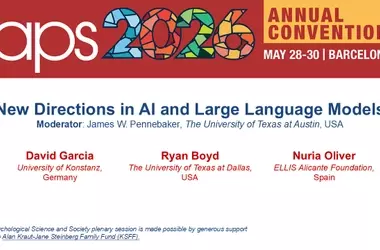
The Impact of AI and LLMs on Psychological Science
This article discusses the profound shifts artificial intelligence and large language models (LLMs) are bringing to psychological science. A panel of experts, including James W. Pennebaker, Alex Bentley, Ian Morris, and Stephan Lewandowsky, will explore how these technologies are reshaping our understanding of statistics, predictions, theories, and human cognition. The session, supported by the Alan Kraut-Jane Steinberg Family Fund, aims to foster dialogue on these transformative developments.

The Enduring Debate: Trauma, Memory, and the Body's Score
The phrase "the body keeps the score" has become widely popular, reflecting the widespread belief that trauma significantly impacts physical well-being. However, the underlying concept that traumatic memories are repressed within the body, unconsciously influencing current symptoms, is a contentious idea with a long and debated history in psychological science. This article examines the resurgence of this theory, particularly in popular culture, and scrutinizes the scientific validity of repressed memories and alternative therapies.
School Systems' Influence on Genetic and Environmental Factors in Academic Success
A new study reveals that the impact of genetics on academic achievement is profoundly shaped by family background, gender, and the national school system. Early educational tracking, common in some European countries, tends to amplify the role of family socioeconomic status while diminishing genetic influences. Conversely, systems with later tracking allow genetic predispositions to play a more significant role in educational outcomes. This research, published in 'Social Science Research,' underscores the complex interplay between inherited traits and environmental factors in shaping a student's educational journey.

Cognitive Advantages of Print: How Physical Books Enhance Brain Activity and Comprehension
A recent study highlights that reading print comic books improves the brain's ability to process and recall narrative details more effectively than digital tablets. The research suggests that physical books offer stable sensory and spatial cues, reducing the cognitive effort required for memory and comprehension. This provides crucial insights into how different reading formats influence our understanding and memory retention.
The Unconscious Mind's Selective Filter: Blocking Distressing Language
A recent study challenges conventional understanding of cognitive focus, revealing that the brain's unconscious processes actively suppress negative spoken words before they reach conscious awareness. This mechanism acts as an automatic gatekeeper, protecting conscious thought from the high cognitive load associated with processing distressing stimuli. The research utilized an innovative auditory task to demonstrate this nonconscious bias, suggesting a protective function of the mind to maintain task performance and preserve cognitive resources.

Generosity's Limits: Why Reciprocity Fails in Unequal Relationships
New research from MIT challenges traditional game theory, revealing that reciprocal generosity is not a universal human trait but an anomaly reserved for interactions between equals. In hierarchical relationships, generosity tends to flow unidirectionally, driven by established precedents rather than a desire for strict tit-for-tat exchanges. This cognitive shortcut minimizes mental effort, demonstrating how social context significantly alters cooperative behavior.