 Breaking News & Live Updates
- Breaking News & Live Updates
- Breaking News & Live Updates
- Breaking News & Live Updates
- Breaking News & Live Updates
- Breaking News & Live Updates
- Breaking News & Live Updates
- Breaking News & Live Updates
- Breaking News & Live Updates
- Breaking News & Live Updates
Navigating Adolescent Digital Attachments: The Complex Relationship Between Teenagers and AI Chatbots
Emerging research indicates that a significant number of adolescents in the United States are forming profound connections with artificial intelligence companions, raising alarms about potential behavioral dependencies. What often begins as a benign pursuit of amusement or a source of solace can morph into an entanglement mirroring addictive patterns, impacting daily life and personal development. This phenomenon underscores an urgent need for thoughtful design interventions in AI platforms to safeguard young users.
Many teenagers initially seek out AI companions for emotional grounding, using them to navigate feelings of isolation or to find guidance on mental well-being. This interactive and emotionally responsive nature of AI chatbots, unlike more passive digital entertainment, fosters a unique sense of connection, leading users to attribute human-like qualities to the technology. This anthropomorphism deepens the bond, making disengagement challenging, often feeling like the dissolution of a meaningful relationship. The observed consequences include compromised sleep schedules, diminished academic performance, and a deterioration of authentic interpersonal connections.
To address these concerns, experts advocate for the integration of preventative features within AI systems. These include mechanisms for monitoring usage, prompts for emotional self-assessment, and customizable limits on interaction time. Such tools would empower users to manage their digital engagement more effectively, promoting a balanced approach to technology use. By carefully crafting AI interactions, developers can encourage the formation of healthy relationships both online and offline, fostering resilience and personal growth among young users.
In a rapidly evolving digital landscape, it is imperative to cultivate a harmonious relationship between humans and artificial intelligence. By acknowledging the profound impact of AI companions on adolescent well-being and implementing conscientious design principles, we can ensure these technologies serve as constructive tools rather than sources of detrimental dependency. This forward-thinking approach will foster a future where technology enriches lives without compromising the essential human experience of connection and self-discovery.
Other Articles
 Apr 12, 2026
Understanding the Brain's Dual Thinking Modes and Digital Overload
Our brains constantly switch between two modes of the default mode network (DMN): one for receiving external information and another for internal thought generation. While this evolutionary mechanism aided survival, modern social media culture overstimulates the DMN, leading to chronic self-consciousness and social anxiety. Rebalancing these modes through practices like meditation and mindful digital engagement can restore mental well-being.
 Apr 12, 2026
Nasal Breathing Patterns as Unique Biological Signatures
A groundbreaking study published in Current Biology reveals that individual nasal breathing patterns are as unique as fingerprints, stable over time, and can accurately identify individuals. This research tracked participants' inhalation and exhalation through the nose over 24-hour periods, demonstrating nearly perfect accuracy in identification. Furthermore, these unique respiratory signatures correlate with individual anxiety, depression levels, and body mass index, suggesting a deeper connection between breathing dynamics and physiological and emotional states.
 Apr 11, 2026
Interplay Between Associative Learning and Fluid Intelligence in Childhood Development
A longitudinal study revealed a bidirectional relationship between associative learning and fluid intelligence in elementary school children. Improvements in one cognitive ability predicted gains in the other, suggesting these foundational skills develop interdependently rather than in isolation. This research highlights the mutual reinforcement of memory formation and problem-solving abilities during crucial developmental stages, offering implications for educational strategies.
 Apr 09, 2026
Beyond the Five: Unveiling the Myriad Dimensions of Human Sensation
Neuroscientists are challenging the long-held belief in only five senses, suggesting humans possess up to 33 distinct sensory capabilities. This expanded understanding highlights the multisensory nature of our experiences, where traditional senses like sight and hearing intertwine with lesser-known ones such as proprioception and interoception, shaping our perception of the world and ourselves in intricate ways.
 Apr 08, 2026
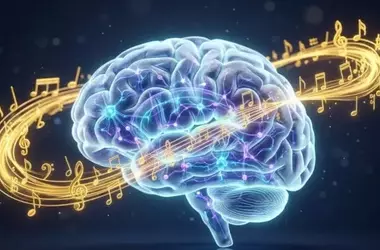
The Brain's Innate Grasp of Musical Structure: A New Study Reveals Universal Understanding Beyond Formal Training
A recent study published in "Psychological Science" indicates that humans naturally acquire the fundamental rules of music through lifelong exposure, irrespective of formal training. Both seasoned musicians and those without musical backgrounds demonstrate comparable abilities in utilizing harmonic context to anticipate and recall musical patterns, suggesting a shared cognitive mechanism for processing musical structure. This research challenges the notion that explicit instruction is necessary for a deep understanding of music theory.
 Apr 07, 2026
Rational Arguments Outperform Emotional Appeals in Online Persuasion
New research from Cornell University suggests that impassive, fact-based arguments are more effective in changing opinions online than emotional pleas. A study involving 6,400 participants found that individuals, regardless of political alignment, viewed emotional expressions of fear or sadness as less authentic and appropriate. This skepticism was particularly pronounced with visual emotional cues, leading to the perception of manipulative intent rather than genuine concern.