 Breaking News & Live Updates
- Breaking News & Live Updates
- Breaking News & Live Updates
- Breaking News & Live Updates
- Breaking News & Live Updates
- Breaking News & Live Updates
- Breaking News & Live Updates
- Breaking News & Live Updates
- Breaking News & Live Updates
- Breaking News & Live Updates
The Quest for Ultimate Authority: Navigating Truth, Lies, and Opinions
In an age where information is abundant yet often contradictory, discerning a reliable source of truth becomes paramount. This reflection critically examines the various anchors individuals choose for their beliefs and decisions, highlighting the inherent limitations of human knowledge. It posits that an overreliance on personal opinions, unsupported by rigorous verification, can lead to significant misunderstandings and challenges, particularly in personal relationships and self-perception. The narrative advocates for a foundational dependence on a perfect, infallible source of wisdom, contrasting it with the transient and often flawed nature of human intellect and societal influences. It argues for a clear differentiation between objective truth, demonstrable falsehoods, and subjective opinions, urging readers to consciously evaluate the origins of their convictions.
Disentangling Fact from Conjecture: A Call for Intellectual Honesty
The journey to establish a personal authority often begins with an introspection into what shapes our understanding of the world. Imagine a hypothetical scenario where one could externalize all their mental constructs onto a digital interface, then meticulously categorize each piece of information as either factual or erroneous. This introspective exercise quickly reveals the vast gray area occupied by opinions – ideas not founded on absolute certainty or empirical evidence. The inherent boundaries of human cognition necessitate this third category, serving as a placeholder for estimations, presumptions, and theoretical constructs. Recognizing this distinction is not merely an academic pursuit but a crucial step towards fostering more transparent and authentic interactions. When engaging in discourse, clearly prefacing statements with phrases like 'my current assessment suggests' or 'based on my limited understanding, I theorize' can significantly enhance communication clarity and reduce potential for misinterpretation. This practice underscores a commitment to intellectual humility, acknowledging that personal beliefs, however strongly held, do not automatically equate to universal truths. Moreover, the article challenges individuals to scrutinize their life's guiding principles, particularly concerning relationships and core values. Are these tenets built upon a robust framework of verifiable facts, or are they merely inherited assumptions, akin to unverified claims? The implications of grounding one's life on unsubstantiated opinions are profound, potentially leading to significant consequences when these beliefs diverge from objective reality. The exploration extends to the realm of spiritual authority, specifically referencing the Bible. It asserts that while faith is an indispensable component, thorough investigation reveals a strong evidentiary basis for its reliability, distinguishing it from mere conjecture. This calls for a careful and reverent approach to sacred texts, acknowledging their timeless veracity even when immediate comprehension is lacking.
Ultimately, this discourse serves as a poignant reminder of the importance of seeking out and establishing a credible, unwavering authority in one's life. It encourages a proactive approach to knowledge acquisition, urging individuals to move beyond anecdotal evidence and subjective feelings towards a more rigorous and evidence-based understanding of the world. By consciously distinguishing between what is known, what is false, and what is merely believed, individuals can cultivate greater wisdom, build stronger relationships, and navigate life's complexities with enhanced clarity and purpose. The fundamental challenge lies in resisting the allure of unchecked personal assertiveness, instead embracing a pursuit of objective truth that transcends individual biases and power dynamics.
Other Articles
 Dec 05, 2025
The Overlooked Art of Listening in Relationships
Effective listening is frequently undervalued in interpersonal connections, yet it forms the bedrock of strong relationships. This article delves into the critical components of true listening, moving beyond mere hearing to encompass humility, focus, and curiosity. It explores common obstacles to attentive listening and provides insights into how cultivating this skill can profoundly enhance understanding and connection with others.
 Dec 05, 2025
Redefining Masculinity: The True Strength of 'WIMPS'
This article challenges traditional notions of masculinity, arguing that 'real men' embody traits of mercy, power, and selflessness, rather than a focus on 'flashing their ME.' Drawing from the biblical book of Titus, it emphasizes that genuine strength lies in a life lived according to sound doctrine and focused on glorifying God, ultimately fostering healthier relationships.
 Dec 05, 2025
Building Resilience to Everyday Stressors for Healthy Aging
This article explores how psychological resilience to minor daily stressors contributes to aging well. Drawing on the American Psychological Association's 'Stress in America' survey, it highlights individual differences in stress coping mechanisms. The piece defines daily stressors as common inconveniences and discusses resilience as an adaptive process. It emphasizes the importance of effective stress response for long-term health and outlines five practical strategies to enhance resilience, including physical activity, social engagement, pursuing hobbies, savoring positive moments, and prioritizing sleep. These approaches aim to mitigate the negative health consequences associated with heightened emotional reactivity to daily hassles.
 Dec 05, 2025
Navigating Relationships: Are You Part of the Solution or the Problem?
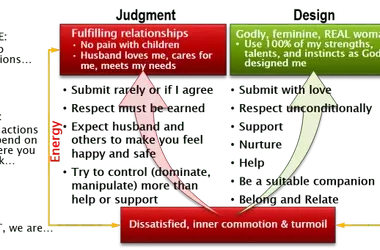
This article explores how individual 'judgments' in relationships, stemming from inherent male and female designs, can lead to painful and unfulfilling interactions. It highlights the oscillation between a 'design structure' focused on godly living and a 'judgment structure' driven by self-interest. The piece argues that understanding and overcoming these judgments, particularly within marriage, is crucial for fostering healthy and divinely-guided connections, ultimately offering a path to becoming part of the solution rather than contributing to relational problems.
 Dec 05, 2025
Understanding the Freedom V Principle: A Guide to Self-Governance and Responsible Liberty
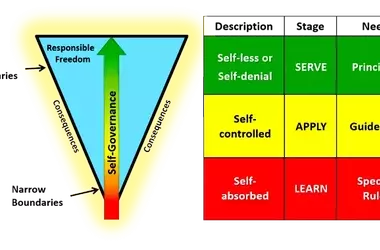
This article explores the "Freedom V Principle," a concept designed to illustrate the intricate relationship between individual freedom and self-governance. It delves into the graphical representation of this principle, explaining how boundaries define acceptable behavior, how freedom expands with increased self-governance, and the consequences of exceeding these established limits. The article also introduces a three-tiered model of self-governance, ranging from self-absorbed to selfless, highlighting its applicability in various organizational and relational contexts.