 Breaking News & Live Updates
- Breaking News & Live Updates
- Breaking News & Live Updates
- Breaking News & Live Updates
- Breaking News & Live Updates
- Breaking News & Live Updates
- Breaking News & Live Updates
- Breaking News & Live Updates
- Breaking News & Live Updates
- Breaking News & Live Updates
Optimizing Client Assessment: A Comprehensive Guide for Practitioners
Selecting the most appropriate assessment tools is crucial for practitioners aiming to provide effective client care. This guide offers a robust, evidence-based methodology for navigating the vast array of available assessments. The core principle involves choosing tools that directly address specific clinical questions, rather than defaulting to familiar options. Crucially, assessment scores serve as a foundation for collaborative dialogue, not as definitive judgments, highlighting the importance of professional discretion. The most valuable assessments are those that align with client objectives, environmental factors, and intervention targets, all while minimizing unnecessary burdens on the client.
When commencing with a new client, practitioners frequently face uncertainty regarding the most suitable measurement instruments. The initial dilemma often revolves around whether to conduct a broad assessment of overall well-being or to narrow the focus to specific areas like mindfulness or self-esteem. The choice of questionnaire also depends heavily on the practice setting. Furthermore, once results are obtained, the subsequent steps require careful consideration. Suboptimal assessment choices can lead to wasted session time, client overload, and data that lacks actionable insights. This comprehensive framework is designed to empower practitioners in making informed decisions about assessments, ensuring they are utilized effectively and at the opportune moment.
The process of choosing the right assessment can be streamlined into five key steps. First, prioritize clinical goals over tool familiarity. The specific needs—whether understanding well-being, self-concept, mindfulness, or agency—should dictate the assessment choice. Second, ensure the chosen measure is appropriate for the practice setting. A tool validated for clinical populations may not suit a coaching or workplace environment; always review the normative sample. Third, evaluate the time investment against the therapeutic benefit. While comprehensive measures offer rich data, they can exhaust clients. Shorter assessments (5–15 items) often suffice for tracking progress. Fourth, never interpret scores in isolation. Assessment results are conversation starters, not final verdicts, and cutoff scores should never replace clinical judgment. Finally, plan the debriefing process in advance. Knowing how to share results, address low scores, and schedule re-assessments is an ethical imperative.
Eight distinct pathways for practitioners guide the selection of assessments based on specific client goals. For instance, in evaluating well-being and quality of life, it's essential to distinguish between hedonic (positive emotions, life satisfaction) and eudaimonic (meaning, engagement, growth) aspects. Tools like the Satisfaction With Life Scale (SWLS) offer a quick snapshot, while the WHOQOL-BREF provides a more comprehensive overview for broader life concerns. When clients struggle with purpose or direction, assessments for values, meaning, and direction, such as the Valued Living Questionnaire (VLQ) or the Sense of Coherence Scale (SOC), can help map their motivational landscape. For mindfulness and attentional awareness, the Mindful Attention Awareness Scale (MAAS) tracks present-moment attention, while the Five Facet Mindfulness Questionnaire (FFMQ) offers a nuanced profile. Assessing optimism and outlook, often a predictor of resilience, can be done with the Revised Life Orientation Test (LOT-R), which measures dispositional optimism. For clients' sense of personal agency, Rotter's Locus of Control Scale or the Multidimensional Health Locus of Control Scale (MHLC) are useful. To understand self-esteem and self-concept, the Rosenberg Self-Esteem Scale (RSES) provides a global measure, while multidimensional self-concept measures offer domain-specific insights. Finally, for assertiveness and interpersonal skills, various validated scales can target behavioral frequency or underlying cognitions. In organizational and HR settings, specialized tools like the Job Satisfaction Survey (JSS) or the Minnesota Satisfaction Questionnaire (MSQ) are more appropriate than general well-being measures, focusing on aspects like pay, role clarity, and autonomy.
Even seasoned professionals can fall prey to common assessment mistakes. Over-assessing clients with too many measures can lead to fatigue and reduced response quality. Treating cutoff scores as definitive diagnoses can mislead and harm the therapeutic relationship. Ignoring linguistic, cultural, and contextual factors can invalidate results, especially since many widely used measures are normed on WEIRD (Western, Educated, Industrialized, Rich, and Democratic) samples. Skipping the debriefing process is an ethical oversight, as clients have a right to understand their results. Using the wrong tool for repeated tracking, particularly those designed for stable traits rather than short-term changes, yields inconsistent data. Lastly, failing to match the assessment to the intervention's specific targets can obscure meaningful progress. Avoiding these pitfalls ensures that assessments remain valuable, ethical, and effective components of client care.
The ultimate aim in selecting assessments is not to identify the most exhaustive instruments but to pinpoint the most beneficial ones for a particular client, within their unique circumstances, at a given moment. Begin by clarifying the primary clinical objective, align the chosen assessment with the specific setting, and always formulate a clear strategy for utilizing the results before any administration takes place. Assessment data should be viewed as a starting point for dialogue and exploration, not as a conclusive judgment. When applied judiciously, assessments can significantly enhance the therapeutic relationship, refine intervention strategies, and provide both practitioners and clients with an honest and shared understanding of their current situation and future trajectory.
Other Articles

7-Day Resilience Reset: Navigating Difficult Periods
Life's challenges can make everyday tasks feel overwhelming. This article introduces a compassionate, week-long resilience reset designed to help individuals cope with loss, change, stress, or uncertainty. It emphasizes gentle steps, self-care, seeking support, and gradually rebuilding a sense of agency, all without forcing premature recovery. The program focuses on stabilizing the body, connecting with others, and acknowledging small achievements, ultimately aiming to sustain steadiness through difficult times rather than rushing the healing process.

Achieving Emotional Sobriety Through Mindfulness in Recovery
This article explores the concept of emotional sobriety, extending beyond mere abstinence from substances to encompass mental and emotional well-being. The author, a recovery coach with 26 years of sobriety, shares personal experiences and professional insights into how mindfulness practices can help individuals navigate challenging emotions, quiet their minds, and cultivate inner peace, ultimately supporting a more profound and sustainable recovery journey. It highlights the importance of addressing underlying emotional triggers and developing new coping mechanisms.

Mastering Emotional Intelligence: The Power of Emotional Literacy
Emotional intelligence, often perceived as an inherent trait, is, in fact, a skill that can be developed and refined. The core to enhancing it lies in cultivating 'emotional literacy'—the capacity to accurately identify, articulate, and express one's feelings. This foundational ability enables individuals to better comprehend and navigate both their own emotional landscape and the feelings of others, paving the way for stronger, more meaningful relationships.

Unpacking Permissive Parenting: Identifying and Shifting Towards a Balanced Approach
This article explores the nuances of permissive parenting, often stemming from a desire to foster happiness but potentially hindering a child's development. It outlines five key indicators of an overly lenient approach and offers actionable strategies for parents to integrate structure and consistency with existing warmth, promoting self-regulation and positive outcomes for children. Backed by research, the piece encourages a balanced parenting style without judgment, emphasizing the importance of both love and clear boundaries for a child's thriving.

Cultivating Inner Peace Amidst Physical Discomfort: A Guided Meditation Journey
This guided meditation, led by Juliana Sloane, offers a unique approach to managing chronic pain and illness. It encourages individuals to develop self-compassion and find comfort by using imaginative and mindfulness-based techniques. The practice focuses on gently bringing awareness to various body parts, inviting relaxation, and then using visualization to transform sensations of discomfort into feelings of kindness and support, ultimately promoting a sense of inner peace and well-being.
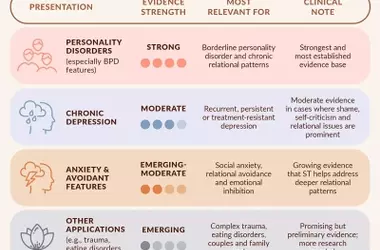
Schema Therapy's Effectiveness: Evidence and Progress in Mental Health Treatment
Schema therapy offers a unique approach to deeply ingrained emotional difficulties by integrating cognitive, experiential, behavioral, and relational techniques. This article delves into the current evidence supporting its efficacy, particularly for complex conditions like personality disorders. It also explores how progress is measured, practical monitoring schedules, and strategies for overcoming treatment plateaus. Furthermore, the importance of therapist training and supervision in achieving successful outcomes is highlighted, providing a comprehensive guide for practitioners considering or utilizing schema therapy.