 Eilmeldungen & Live-Updates
- Eilmeldungen & Live-Updates
- Eilmeldungen & Live-Updates
- Eilmeldungen & Live-Updates
- Eilmeldungen & Live-Updates
- Eilmeldungen & Live-Updates
- Eilmeldungen & Live-Updates
- Eilmeldungen & Live-Updates
- Eilmeldungen & Live-Updates
- Eilmeldungen & Live-Updates
Mastering the 'Stay' Command: A Comprehensive Guide to Dog Training
Empower Your Dog with the 'Stay' Command: A Guide to Enhanced Obedience and Safety
Initiating the 'Stay' Command: Establishing a Foundation with 'Sit' or 'Down'
To begin teaching your dog the 'stay' command, first decide whether you will use a 'sit' or 'down' position as the starting point. Your dog must already be proficient in executing these basic positions before you can successfully introduce the concept of remaining stationary within them. This foundational step ensures a clear understanding of the initial posture required for the 'stay' cue.
Cultivating Self-Control: Leveraging Treats for Impulse Management
Developing your dog's impulse control is crucial for teaching them to remain still when instructed. Start by holding a treat in your open palm, positioned approximately ten inches from your dog's face. If your dog attempts to reach for the treat, immediately close your hand. Conversely, if they exhibit patience and stillness, bring your hand to them and offer the reward. It's vital that the dog does not come to your hand for the treat. During this phase, avoid verbal cues; the act of closing your hand upon movement serves as sufficient communication for your dog to understand the desired behavior.
As training progresses, gradually extend the time your palm remains open, requiring your dog to wait longer before receiving the reward. This practice in impulse control helps cultivate a dog that anticipates and seeks your confirmation, rather than acting impulsively. Once your dog consistently waits for their reward, you can begin to introduce more challenging scenarios. This stage demands considerable patience, as dogs are naturally inclined to follow. Proceed slowly, prioritizing success in early sessions to prevent mistakes, which ultimately simplifies the entire training process.
Integrating Movement into the Training Protocol
The next phase involves incorporating movement while continuing to refine impulse control. At this point, you no longer need to hold a treat in your hand; keep it readily accessible in a pouch for quick rewards. Take a small step away from your dog, perhaps five inches. If your dog maintains their position, promptly reward them.
Your dog might shift their body slightly, but their feet should remain planted. After each successful reward, count to five before giving the release cue, such as "free," allowing them to move. This helps them distinguish between remaining still and being permitted to move. During these movement breaks, let your dog explore or sniff, but avoid making the break overly exciting; the 'stay' command should be perceived as more rewarding than freedom.
Should your dog move as you step away, immediately use a distinct sound, like "ehh, ehh," and step back into their space. This action should guide them back to their original spot. Precise timing is paramount here; immediate action upon movement helps your dog comprehend the message. The corrective sound should be firm yet neutral, not punitive. It serves solely to indicate that moving was not the desired action. Note that the verbal cue "stay" is not yet introduced; it will be added once your dog has a solid understanding of the physical action.
Escalating the Training Challenge
As your dog becomes more adept at staying put when you take a small step back, gradually increase the complexity of the exercise. Begin by practicing the 'stay' command while you move sideways. Take a step to the right; if your dog remains stationary, return and reward them. Repeat this process by stepping to the left. Progressively increase the number of steps you take to the side, rewarding your dog after each successful duration.
It is crucial to only introduce increased difficulty after your dog has demonstrated consistent success at the current level. Remember to integrate movement breaks, always releasing your dog with a verbal cue like "free" before they decide to move on their own. The more you reinforce this behavior without your dog prematurely breaking position, the more effective the training will become for both of you.
The ultimate objective of moving left or right is to eventually complete a full circle around your dog without them shifting from their spot. The challenge intensifies as you approach your dog's rear. Standing directly behind your dog is often the most difficult part, as dogs typically follow their owners, and losing sight of you can be disorienting. Approach this stage with caution; most dogs will falter when their owner first disappears from view. Always return to your dog to deliver the reward, as having them come to you for the treat can cause confusion.
Incorporating a Hand Signal with the Verbal Command
Once your dog can maintain their 'stay' position even when you move completely around them, it's time to introduce the verbal cue "stay" along with a corresponding hand signal. This introduction should only occur when you are highly confident—at least 95 percent certain—that your dog will remain in position without breaking. Repeatedly using the "stay" command when your dog moves prematurely can diminish its effectiveness. A common and useful hand signal resembles a stop sign, with your palm extended. Dogs are often more responsive to body language than verbal commands, making it beneficial to teach both the word and the hand signal concurrently for maximum clarity and understanding.
Expanding the Distance of the 'Stay' Command
With your dog proficient in the 'stay' command, the next step is to progressively increase the distance between you and your dog. When introducing this new level of difficulty, initially offer rewards more frequently and rapidly. As your dog's proficiency strengthens, you can gradually reduce the quantity and frequency of treats. Over time, the goal is for your dog to remain in a 'stay' position even when you leave their immediate line of sight, such as stepping out of the room.
Common Mistakes to Avoid for Effective Dog Training
When increasing the complexity of a behavior, avoid simultaneously adding both duration and difficulty. Focus on one element at a time to prevent overwhelming your dog. Over time, you can integrate both aspects. Dogs learn to associate specific sounds with actions, not human language. Choose command words that have distinct sounds or syllables to prevent confusion. If cues sound too similar, your dog will struggle to differentiate your requests. Always remember to release your dog from a command once the task is complete. This prevents them from breaking the behavior prematurely and reinforces the structure of the command. In the initial stages of teaching a new behavior, generous use of treats is beneficial as it creates a positive association with the action. As your dog's understanding grows, you can gradually reduce treat dependence. When introducing new locations or increased levels of difficulty, proceed slowly. It's always more effective to set your dog up for success from the outset rather than allowing them to fail during the learning process. Introduce the verbal cue for a trick or behavior only after your dog consistently performs the action reliably. This preserves the value of your command word and ensures your dog is well-prepared for success.
Deciphering Your Dog's Reluctance to Follow Cues
Dogs do not inherently generalize skills across different environments. To truly master a behavior, a dog must practice it in various locations and under diverse distractions. For instance, if your dog responds to their name at home but ignores it at a new park, you need to revisit the basic training in that new setting. Whenever you introduce a new location, it's best to start with the fundamental aspects of the behavior to ensure your dog's success.
Repeatedly using a cue without your dog responding diminishes its value. Each instance where your dog is distracted or fails to comply after hearing the cue makes the word less effective. Teaching your dog to 'stay' is fundamental for their safety and enables you to bring them to various places without concern. Utilizing positive reinforcement makes the 'stay' command an engaging learning experience, encouraging your dog to enjoy remaining still.
Frequently Asked Questions: Understanding the 'Stay' Training Process
The duration required to train a dog to 'stay' varies significantly based on the individual dog and the consistency of the training efforts. By diligently following the outlined steps and maintaining a patient approach, most dogs can achieve proficiency in the 'sit and stay' command within a relatively short timeframe.
Weitere Artikel
 Jan 12, 2026
Unraveling the Intelligence of Cats vs. Dogs: A Comparative Analysis
The long-standing debate over whether cats or dogs are smarter remains complex. While dogs are often seen as more trainable and emotionally intelligent due to their social nature and domestication history, cats excel in problem-solving and independent thought. This article delves into various intelligence factors, including brain size, trainability, problem-solving abilities, and social intelligence, concluding that both species possess unique cognitive strengths shaped by evolution and environment.
 Jan 12, 2026
The Crucial Role of Sleep in Canine Learning and Training
A 2017 study from Hungary and expert opinions emphasize that proper training is vital for dogs, enhancing behavior, stimulating their minds, and strengthening the human-canine bond. While initial learning of commands like "sit" can be quick, retaining new skills requires repetition, time, and, significantly, adequate sleep. Research indicates that sleep helps dogs process and consolidate new information, improving their ability to recall learned cues, particularly in the long term.
 Jan 12, 2026
Overcoming Canine Separation Anxiety: A Modern Training Approach
This article explores an innovative online training method to help dogs with separation anxiety, particularly relevant as owners return to work after extended periods at home. It details the journey of a dog named Emma, whose severe separation anxiety was successfully addressed through a specialized, incremental online program developed by expert Malena DeMartini, emphasizing the effectiveness of remote observation and tailored exercises to build a dog's confidence in being alone.
 Jan 12, 2026
Preparing Your Canine Companion for Daycare or a Walker
Ensure your dog thrives in daycare or with a dog walker by offering experiences that mimic these settings. Train them to respond to commands, exhibit good leash manners, and feel secure in a crate. Familiarize them with new people and dogs, ensuring a positive transition into these essential services.
 Dec 25, 2025
Enhancing Well-being: A Guide to Boosting Mood and Happiness
This article explores various strategies for improving mental and physical well-being, emphasizing the positive impact of nature, acts of kindness, physical activity, creative pursuits, skill development with pets, pet interaction, and volunteering. Drawing on scientific research from universities like Regina and Harvard, it provides actionable advice for reducing stress, combating negative thoughts, and fostering a greater sense of purpose and happiness in daily life.
 Dec 02, 2025
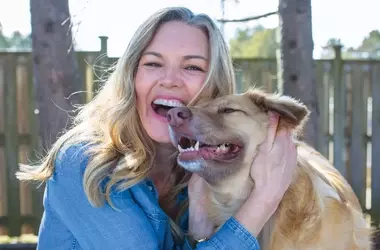
From Teacher to Actress: Kate Drummond's Journey and Passion for Animal Rescue
Kate Drummond, known for her roles in 'Utopia Falls' and 'Ghostwriter,' embarked on an inspiring career change from elementary school teacher to actress at 35. Her story is a testament to pursuing one's true calling and the power of second chances. This philosophy extends to her fervent support for animal rescue, advocating for organizations that provide loving homes for neglected and abandoned dogs, including The Snoopi Project, Playa Animal Rescue, DIBS, and BARK.